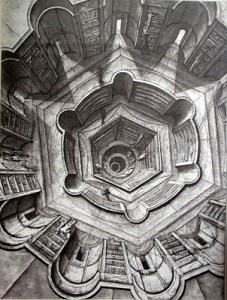
My friend and I spoke of Borges’ Library of Babel:
“Do you think that it could actually be built?” I asked.
“Of course not!” he said. “It’s infinite.”
“But is it infinite countably, or infinite uncountably?”
“Uncountably infinite.”
“How could it be?” I ask. “It it’s made of a finite number of orthographic characters. It must be circumscribed by some countable infinity.”
“Even so,” my friend says, “it’s still infinite.”
“What if we relaxed the notion of infinity ever so slightly. What if we said that, for example, it wasn’t necessary to finish every sentence with every possible character. In fact, let’s say that we imposed a rule of comprehension on the Library of Babel. Only sentences that make grammatical sense can be included in any volume.”
“You’re talking about something different entirely from what Borges proposed.”
“I suppose I am. But how many meaningful things can be said? Are there an infinite number of meaningful thoughts? Can we say that certain statements reduce to other statements, and count them only as one?”
“My instinct is that there are still infinite things to say.”
“So the library must still be infinite.”
“So it would seem.”
“What if all statements had to be true?”
 To Have and Have Not
September 19, 2016 at 8:05 am
In that case we should consult WVO Quine.
LikeLike