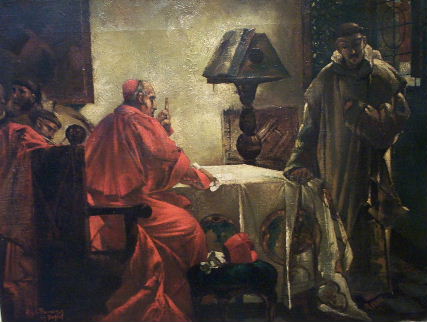
I’ve always been a fan of Russian literature, though never an expert. Certain parts of the books I’ve read have stayed with me though. I am not a careful follower of current events, and this is not to be read as an indictment of Trump. Nevertheless, it’s all too easy to give up thinking for yourself; all too easy for the people that rule to enable it. As such, I thought I’d share with you an excerpt from one of Dostoevsky’s greatest works.
From Chapter Five of Dostoevsky’s epic Brothers Karamazov I’ve summarized and quoted parts of ‘The Grand Inquisitor’:
The brother Ivan details the plot of a poem he has yet to write. In the poem, Jesus reappears in the heart of the Spanish Inquisition, just as Seville’s Grand Inquisitor has burned a hundred heretics at the stake.
On appearance in Seville, the masses immediately recognize Jesus. He performs some number of miracles, including the resurrection of a small child. Then he is thrown in prison by the Grand Inquisitor himself.
To his prison cell, in the “deep darkness”, the ninety-year-old Inquisitor comes to Jesus, who stays silent throughout his visit. While he recognizes his prisoner as Jesus — God in flesh — he tells Jesus that he will burn him at the stake in the morning.
Jesus preached freedom by faith, but didn’t make a hasty return, creating a distinct problem for those early faithful. After fifteen centuries, the church has solved the problem by managing to convince the people to rely entirely upon faith in the church. Finally, the people see themselves as completely free. They have laid all of their freedom at the church’s feet by putting their faith entirely in the church’s prescriptions for living. Now, with the arrival of Jesus, faith is fulfilled, freedom complete.
No, Jesus is messing everything up. He is going to return everything to confusion. The Inquisitor points out that if Jesus had fallen to his first temptation (Satan’s admonition to turn some rocks to bread so as to feed his starving self), it would have amounted to buying the people’s freedom — acquiring their faith — with a few loaves of miracle bread. “Instead of taking over men’s freedom, you increased it and forever burdened the kingdom of the human soul with its torments.” (Pevear and Volokhonsky, 255)
The Inquisitor reiterates by reminding Jesus of his refusal to leap from the heights or to come down from the cross; more temptations that fulfilled would exchange freedom for a kind of faith. “You did not come down [from the cross] because, again, you did not want to enslave man by miracle and thirsted for faith that is is free, not miraculous.” (256)
Jesus did perform miracles of course, but not until after he survived his temptations in the wilderness (Matthew 4:11 tells that, post-temptation, the devil left him; Matthew 4:17 tells us that it is then he began to preach). The Grand Inquisitor does not want to let Jesus loose on the world with the prospect that he will again ask people to choose for themselves what to believe, something that still happens even in the presence of miracles, “miracles”, and such. I don’t know about you, but in the Age of Reason I would be highly suspicious of any dude that turned up appearing to produce the output of an entire bakery’s morning shift using only a single loaf. But there’s probably a San Francisco startup working on it now. Pray for it.
The Grand Inquisitor goes on to explain to Jesus that the church has prudently taken steps to capture the people’s faith, despite the lengths to which Jesus had left them free (hanging?) to choose for themselves. The church’s recipe is miracle, mystery, and authority: hocus pocus, mumbo jumbo, and auto da fé. “Then we shall have given them quiet, humble happiness, the happiness of feeble creatures, such as they were created.” (258)
And bread. Lots of bread. “For who shall possess mankind if not those who possess their conscience and give them their bread?” (258)

Courtesy Anarchist Life
Thanks to Mark Addleman.
 To Have and Have Not
Leave a comment