Search

To Have and Have Not

technical musings and more

Author

dbmartin00

Something that’s been through a lot…

Last Wednesday, I was on my way to work.  I was in traffic, of course.  Near the intersection of Highway 17 and San Tomas Expressway, I stopped behind one of those all white utility vans favored by contractors everywhere.  I could see a pile of paint cans through the back window.

What caught my attention was the bumper of this van.  I thought to myself, “how on earth did this thing get that banged up and still survive?”  I was so impressed that I grabbed my phone and took a picture of it while we were still stopped.

In years past, I owned a Nissan Altima that I bought just after moving back to California.  On the third week of ownership, I parked at a movie theater in Cupertino and came back to find a big dent in the right corner of the bumper.  I was furious, but there was nothing I could do.

I had every intention of pulling the dent out, but days turned into weeks and then into months.  Years passed and the dent stayed in my bumper.  Eventually, I reasoned it made it easier to find in a parking lot. Finally, I decided that the dent was actually a reflection of myself:  damaged, but good to go.

For almost all of my adult life that is how I’ve seen myself.  For a number of years, I spoke with a trusted advisor who gently prodded me to “pull out the dent”.  When the “dent” becomes part of your identity, however, this is easier said than done.

In recent times, the battlefield phrase “walking wounded” has taken on new meaning, extending to describe the emotionally scarred, going through life crippled by psychological injuries, unable to fully heal.  Like me, many of these have chosen to hold on to their injuries as a kind of identity.  I lost my father at the end of 2015, and have since witnessed my mother progress through many stages of grief; she is more resilient than me, and is now living an active, positive life.  I’m not sure I’ve even dealt with my grief yet.

Does pulling out the dent mean forgetting the accident?  If you don’t want to forget, if you’re even afraid to forget, can you ever be normal again?  Is there a way to remember, but to simultaneously let go?

I am haunted by these questions.  Today, however, I can say that they no longer control me.  Like that famous phrase, befuddled in origin (and in reverse), I grew healthier again all at once, and then very slowly.   More than a decade since the damage was done, I realize that the damage wasn’t done when I took the dent.  My entire life is about the damage, and also about its inverse.

I am not here only for myself.

Clarissa, from The Hours:  

“That is what we do. That is what people do. They stay alive for each other.”


MOM GOES TO CHINA

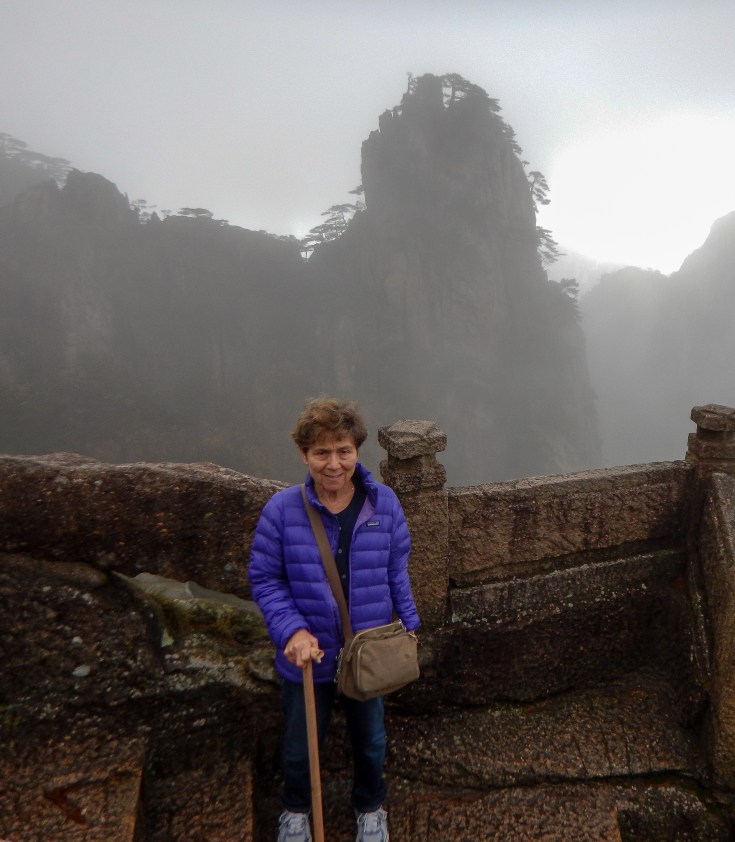
When I was a college student, I left for most of a year in China and Taiwan. My mother was travel jealous, and vowed that she would follow me someday.  Years passed, and complications followed, and she ended up traveling to Hong Kong and Taiwan with my family several years ago.  Sandy Martin, intrepid world explorer, wasn’t content to stop there, however, and when a family relative offered to take her on a month-long trip to the P.R. China, she couldn’t help but follow.

dscn0913

There are ninety pictures that could accompany this story, but my story is one of admiration and respect for her unrelenting willingness to explore the world.  Before she married my father, she spent months exploring Europe by herself, stories of which I think I still have not heard.  There was a night in a hotel by the Black Forest.  There was a Frenchman who was a little too forward (imagine that).  There was Copenhagen, and the mermaid.   And my dad, who skated through two weeks of sight-seeing before returning to the US.

Dad traveled extensively with mom before he was gone.  But mom’s ambitions are plainly beyond those that Dad could have supported.  As she presses into her seventies, it would seem as if she has the plaintive enthusiasm of a college graduate.  What country she decides to conquer next, what mountain she decides to climb, can only be left to the imagination.  Cheers to Sandy Martin as she contemplates her next exploit.  Like Alexander, she may some day despair that there are no worlds left for her to conquer.

L’chaim!

David


IN CONVERSATION WITH DAD

I talked to my dad today.  He died the day after Christmas 2014, but he’s still a daily part of my life.  I think of him most often when I’m on my way, or on my way home from work.  That’s when we used to talk, because I’ve had long commutes.  He would listen to my complaints gently, and guide me off in a wise direction.  I’ve always thought of my laptop as my violin, and he always reminded me it belonged to my employer.  He was an attorney, so I believed him.  I still think of my laptop as my violin though.

For the last few weeks, I’ve been unusually busy.  Email has been like space invaders; the more I reply and delete, the faster they seem to arrive.  Still, I was encouraged when I heard our CEO, in a town hall meeting this week, say that he didn’t care how hard people worked.  He cared about results.  He must also be a John Wooden fan: “never confuse activity with achievement”.

I managed to get into some trouble when I declared one of my projects was behind.  I don’t own this project, I co-own it.  My co-owner says the project is on track.  Sure, it’s embarrassing to hear that things are behind, but I figure he’ll look better if I’m wrong, and be happy that I was managing expectations down if I’m right.  Based on past experience, it doesn’t make sense to tell people that everything is on track when you have doubts that’s the case.  The complexity of shared ownership must be the distinguishing aspect of all this. Nobody expects a single product to be owned by two different parties.  It must be confusing when mommy says one thing and daddy says another (though my children seem perfectly happy to blame daddy whenever necessary).

When I talked to dad, I talked about these things.  I also talked about the places I felt I was failing.  I told him that, if he knew now what I had been through in my life, then maybe he would understand why I am operating the way that I am.  I like to think that this gentle, careful man would see how I have no qualms about throwing myself under the bus.  He was fastidious and anxious, risk-averse.  I am swift and brash, gut-driven.  We couldn’t be more different in our professional styles.  I’ve never been fired, and neither was he.  Is getting fired a failure?  I suppose it would depend on why.

One thing I’ve been taught as a product owner is that I shouldn’t try to protect my engineers.  I’m starting to think that this is going to be one of my continual failures.  I have to protect my engineers!  They do the work I ask them to do.  If any other party can come in and usurp my backlog and interrupt sprints in progress, then are we Agile?  The scrum master is there to make sure the team is efficient, and not to run interference.  They live in the same hierarchy as the engineers. Nobody else can help them keep their focus better than me.  Every business has distractions.  Who will block new distractions from them as they perform their work in progress?  I owe it to the people that work for me to block as much of the “noise” as I can block.  Where am I going wrong?

Dad had nothing to say tonight.  Then, I didn’t think he would.  I don’t much believe in God anymore, which must torture my dad, but I still think Jesus was amazing.  I’ll never forget many of the lessons I learned reading about Jesus.  Whatever else he did, he taught the world that being a leader is being a servant.  Lao Tzu and others had the same idea.  I’d rather give up working than give up on the conviction that I serve the people that work for me.

That makes me think my dad would be proud.

IT MATTERS, BUT IT DOESN’T MATTER

An old friend told me recently that the brain was an appliance, like a microwave.  It’s a miracle, but it’s only good for certain tasks.  If you expect it to freeze anything, you’re in for frustration.

But that frustration drives us.  We go through our lives striving to answer questions that the brain isn’t built to answer.

The solution, he told me, is the heart.

The heart doesn’t have any senses.  Does it?  The Chinese use one word for heart and mind, 心.  You’d think they would be rubbing the philosophical significance of this in on the rest of us, but I’m not convinced they’re often aware of the difference.  If the difference was on the surface, then surely they’d hear about it as they arrive, strangers in a strange land.  But this difference is at a deeper, root metaphorical level.

We can choose to ponder a path into the future, or we can take the Kierkegaardian approach of observing that there is no path to ponder: life can be over at any instant, and there is no predicting the future.  I can’t help but plan.  Still, I stop my frenetic planning at times to consider that all this is empty of meaning.  Like Kiergaard, I have to consider the possibility that a roof tile will blow off a neighboring building and strike me dead.  If not a roof tile, the car ahead of me.  Or the cancer that is silently growing within.  Or just despair.

The heart does have senses.  All of them.  I can listen to it, but my heart sings a funeral dirge.  On some days, I am drawn down by it.  On other days, I recognize that this song — however sad — is a celebration of life.  In endings, are beginnings.  There is no alpha and omega.  There is alpha and omega and alpha again.  Some day, things will truly end, I suppose.  And when that happens, nothing will change that I have been.


LAYLA’S ‘INCREDIBLE JOURNEY’ MEETS THE ‘EDGE OF TOMORROW’

While we walked Layla today, Eli and I wondered if it would be funny to combine the classic Disney ‘Incredible Journey’ — which followed three pets as they wandered hundreds of miles back to their home — and the more recent sci-fi film’ Edge of Tomorrow’, which starred Tom Cruise and Emily Blunt.  The premise of ‘Edge of Tomorrow’ is similar to ‘Groundhog’s Day’:  Tom Cruise keeps being reincarnated until he finally reaches his goal of saving earth from the aliens.  Eli and I agreed that the rural landscape of 1963 was a walk in the park for the pets compared to the urban challenges of 2016.  So we wrote a little of the screenplay.

Day Zero:

Layla awakes in the gutter.  It’s night.  Nothing she smells is familiar.  She remembers jumping out a car window to chase a squirrel.  She isn’t sure if her family saw her jump.  She’s got to find them.  She’s got to find home.

She crosses the street and is hit by a car.

Day One:

Layla awakes in the gutter.  It’s night.  Nothing she smells is familiar.  She looks to the left and she crosses the street and is hit by a car coming from the right.

Day Two:

Layla awakes in the slightly more familiar gutter.  She decides not to cross the street.  Wandering along the sidewalk, she encounters another stray dog.  A much bigger dog.  It growls at her and they fight.  The other dog bites her throat out.

Day Three:

Layla awakes in the familiar gutter.  It’s night.  She sees the big dog down the street.  She looks to the left and waits for a car to pass.  She looks to the right and waits for the oncoming car to pass.  She crosses and is hit by another car making a right turn onto the street.

Day Four:

Layla awakes in the gutter and trots towards the intersection she can see in the distance.  She sees a girl pushing a button.  The crossing light turns green and the girl crosses.  She follows her across the street.  Dang.  It was that easy!  Layla is hungry.  She sees a garbage can and considers it, but decides to beg the girl for food.  Layla is a pro at this, but the girl takes Layla home too.  Weeks pass.  They feed her well enough, but she is trapped in their house, not her own home.  She misses her real family.  One day, the girl leaves a chocolate bar sitting out.  Layla wolfs it down.

Day Five:

Layla wakes in the gutter.  It’s night.  Again.  Wow!  Chocolate really is poisonous to dogs!  She files away this useful information as she heads for the street corner.  She crosses with the girl, but doesn’t beg.  She is hungry, but finds water in a creek running nearby.  The wildlife (squirrels) look at her and take flight.   She chases them to exhaustion and collapses on a sidewalk near the road.  A friendly man sees her and takes her home with him.  Layla sees a bag of M&Ms on the car seat, snatches the bag and wolfs them down.

Day Six:

Layla forgets not to cross the road.  It’s a Buick this time.

Day Seven:

Layla is depressed and hangs out by the gutter.  A cat approaches.  Her name is Flounder.  She’s all white, and skittish.  The big dog approaches, looking for trouble.  Flounder arches her back and hisses; the dog takes off.  Layla is impressed.  What does Flounder want?  Flounder has been living on the street like Layla.  She wants a home.  Layla tells her that they can get a home if they work together.  Flounder agrees.

Layla shows Flounder the button at the intersection, but Flounder is scared and slow to cross.  Layla watches her become road kill.

Day Seven through Day 512:

Layla heads in every direction.  No matter where she goes, she ends up starving in rural obscurity, killed by rival gangs, mown over by cars or buses.  It’s useless.  Finally, she lets go of her goal of going home.  She decides to just live her life the best way she’s learned how.

Day 513:

Layla awakes in the gutter.  She sits, thinking hard about the day to come.  Flounder approaches and they exchange greetings.  Layla asks her how her left paw is coming, and Flounder is stunned.  How did he know she had injured her left paw?

They go to the intersection.  This time, Layla demonstrates a half dozen times that the cars will stop when the button has been pushed.  Finally, Flounder follows her across the street and they arrive safely together.  Layla starts to head north, and Flounder tells her to stop.  They have to go back to the other side of the intersection.  It’s the only way to get back into the city.

They cross again, together, and head west.  Flounder has seen a lot of the city, but can take them only so far.  They come on a stretch of street with a dozen stray dogs.  Layla fights as many off as she can, but Flounder is killed.  Layla escapes, but walks the streets alone in sorrow.  Finally, she sneaks into a corner store and snarfs three bars of chocolate.

Day 514:

Layla awakes in the gutter.  It’s night.  She sees Flounder and gushes all the things she knows about her.  She has to come with him.  They race through the streets they had passed before, and Layla urges her on a detour around the street with the gang of dogs.  They reach place that, finally, Layla recognizes.  Flounder is reluctant to follow; this is a part of town unfamiliar to her.  But she comes with him.

They reach the doorstep of 32108 Isleview Drive.  Layla’s owner Isabelle answers the door.  She has returned at last.

At first, mom is reluctant to take Flounder into the house with her.  But when they discover that Flounder will push her head into their mouth when they open wide, their hearts are broken and they take her in.

Flounder and Layla live happily ever after.


WAITING FOR THE RAIN

The weatherman said it would rain hard on Friday.

During the commute, he said.  Snarling traffic, he said.

But by Saturday morning, only a sprinkle had fallen.

She had put on her rubber boots when she awoke,

And paced about in the yard.

The family dog followed her about with curiosity.

“Where is the rain?” she said.

Saturday passed in meteorological silence.

The clouds glared down their disapproval,

But they spoke nary a word.


By Sunday morning, the atmosphere was dark and ominous

(as it had been since Friday),

But still barely a drop had fallen.

That night, her mother and brother had taken the dog for a walk before dinner.

I went out to the front of the house to fiddle with the car

And came back wet.

I called to her, and said, “The rain is here!  I can feel it coming!”

And she grabbed her pink umbrella and spilled out into the yard.

“Dad!” she cried, “They’re going to get wet!”

I yelled back, “They won’t melt!”


And then, the rain it came in waves and waves.

It soaked the earth through.

The earth, the birds and trees, were quiet from the falling water.

The roof of the house tapped out the white noise

Of gravity-stricken dew.

“It’s raining,” she shouted.


THE DOXOLOGY

As a kid growing up in Presbyterian churches, I grew accustomed to singing the same hymn with every service.  It was called the doxology, and I can still sing it from memory:

Praise God from whom all blessings flow.
Praise Him all creatures here below.
Praise Him above ye heavenly host.
Praise Father, Son, and Holy Ghost.

This isn’t the only doxology, but it’s the one that was being sung in the churches I attended, 1980’s St. Louis, Missouri and 1990’s Los Altos, California. Eliminating a few outliers, it’s been over twenty years since I was in a church service and expected to join in singing this song.

My six year old daughter started asking me some questions about God recently, and I suddenly felt like singing her the doxology.  I had to explain to her the meaning of “all creatures here below”,  and “ye heavenly host”.  Then there was the usual gyrations around a meaningful explanation for “Holy Ghost”.  In the end, I’m not sure how much she understood, which bothered me because I had initially thought the doxology was a good introduction.  This is a case of what I call “summary sickness”:  the short form is more confusing than the long one.  This disease is endemic to philosophy and religion.  In short form, even the Krebs cycle is more easily grasped than the Westminster Shorter Catechism (which isn’t even all that short by Netflix standards).

Still, her questions sparked me to think about faith for only the 1,000,000th time in my life (it generally happens more than once a day).  Years ago, I told myself it was time to give up.  It’s an obstinate addiction though.  All sort of things can make me reconsider.  If you remember high school chemistry, you might remember electron orbitals.  Like an electron in its orbital, you can say with some statistical certainty that I’m in one place or another, but you can’t tell for sure without looking.  But looking perturbs the system.  There’s no way of knowing where my “faith electron” might actually be; even I don’t know.

One religious philosopher insisted it wasn’t enough for beliefs to be passed on from one generation to the next.   Faith was to be worked out, in fear and trembling, by each generation, starting from scratch.  This jives with my own interpretation of the greatest commandment, “Thou shalt love the Lord thy God with all thy heart, and with all thy soul, and with all thy mind”.  With all my mind?  If you insist, then it surely isn’t enough to take the word of my predecessors alone.  Is faith something that can work for me?  Is there still a guttering flame, or only the smoke left behind by a flame snuffed out?

If faith is a belief in the unseen, then we run into problems here in the Age of Reason.  But if we don’t perceive the universe directly, rather through our sensory organs, we’re in trouble all the same.  You have to include the brain, its structure and biases too; it interprets and colors the sensory input.  Descartes’s error was in supposing a brain could exist in a vat in the first place.  It would seem that performing objective science on the unseen is a fast fail, but is objective science using our senses intellectual quicksand as well?

Lev Shestov illustrates.  Suppose we collect drops of water every day for years, analyze them in a laboratory, and draw conclusions about water in general.  Have we given an objective foundation to our understanding of water, or only those droplets we collected?  Before you deny the point, consider the possibility that all water was collected from a particular stream, and at a particular time of day.  Is that objective enough?  Even if you generalize to a large number of collections, the collections will never approach the analysis of all water.  It is the action of science to observe and generalize about what our senses tell us.  There is still an action of faith here.  This faith deals in that which is observable with our own imperfect senses, and is more satisfying than studying the invisible, but is a kind of faith nonetheless.  Remember that evolution was a fraud until it wasn’t.  Science is littered with reversals.

On some mornings, I cry in my car.  It can happen at other times of day, but almost always in the morning.  I theorize that my mind starts its day fresh, undistracted, and with a clear view of the world and all its complexity.  I cry because ‘complexity’ can be something more miserable.  Far more miserable.  Then, the rest of the day becomes an exercise in distracting myself from that thought.  If we’re froth bubbling on a rock hidden in space, what does any or all of this mean?  Where are we going?  Are we just aiming to spread?  Is that a morally and intellectually satisfying goal?  Are we even supposed to be considering that, or was consciousness a vicious mistake of nature?

Dr. House believes, “…all this isn’t simply a test.” But if I accept that, what is it then?  In my dreams, all my life, I am being tested.  The method changes, but the dreams do not.  Do I want to be taking the test?  Does it comfort me to think that someone or something is hovering over us, ready and waiting for the right moment to get involved?  Are there examples throughout history of such involvement?  Can I fantasize that God is imperfect, but still out there?  In the Age of Reason, it would seem that science-fiction is becoming the new doctrine of the unseen.

Still, what is the nature of my misery?  Can I cooly address it, declare victory and move on? I’m allowed to think selfishly about my quality of life, my happiness.  I don’t need to have a bulletproof theodicy, do I?

Regarding the Book of Genesis, I’m guessing that most people would say Eve ate of the Tree of Life.  This isn’t correct.  The Tree of Life and the Tree of the Knowledge of Good and Evil were both in the middle of the garden.  I was once booted out of a bible study for pointing out that Eve hadn’t even been created when God told Adam not to eat of the latter (I suppose we are to assume that the First Man was much better at remembering and relating such instructions to his spouse than modern man).  The Tree of Life was fine for eating.  For all we know, Adam and Eve played nerf football under the Tree of Life, while God lay in the grass nearby heckling their throwing skills.  Hey, it was paradise!

No, they ate of the Tree of the Knowledge of Good and Evil.  Then they fell and were exiled.

I have to wonder what kind of parent abandons His children over a single act of disobedience, a sentiment that I imagine has been felt by many before me.  When Adam and Eve became like God, knowing the difference between good and evil, there may have been nothing left for God to do except to teach them how to be gods themselves.  Being alone and forced into self-reliance comes with much suffering.  Suffering can come with wisdom.  The paths in front of us are legion now.  We began our wandering long ago, and, if I insist on intellectual honesty, I should conclude we are still completely alone.   Others may have a faith in the unapprehended; with my health problems, I can’t afford to do the same.  Is it possible that I’ve been written out of God’s will by a loophole?

All who wander are not lost, but are they any wiser?


ODE TO LEW

One of the reasons I moved to WordPress is that it is awkward to write about many topics I find interesting and wish to share.  I haven’t worked for Lewis Cirne for many years now.  He is the chief of what some (not all) of my co-workers would call a competitor.  Still, I’ve written a lot now about people and events that were major milestones in my life, and Lew qualifies so completely that I must speak up.

First, Lew gave me one of my greatest career gifts.  When I met him in 1998, he had just quit his day job to develop the product that would become Wily Introscope.  I missed a chance to be his intern the following summer, but I wasn’t sad because I saw him click with another great mind, Dan Scholnick.  When I finally started full time work for Lew in August of 2000, I was nervous as hell that someone was going to find me out.  I thought it would rapidly be apparent that I didn’t know what I was doing, that I was just wasn’t all that valuable.

Lew brought what must be called a party atmosphere to many encounters, one-on-one and company-wide.  There was a disco ball in our conference room.  He had new employees bang a gong as they were introduced.  He always had a smile, always a way to make you relax, always a positive attitude.  I’ve met plenty of positive people in my life, but nobody quite like Lew.

When I think back about my first work experiences, I realize now that he shaped how I think about work and how I want to be when I’m at work.  In my meetings today, I sometimes realize I’m “channeling” Lew when I toss a pun into the conversation, tease someone, or gently self-deprecate.  I read recently that Lew has a philosophy of keeping his meetings to six people or fewer (I love the picture with this article better; it’s so him).  We didn’t have this rule in the Wily Technology days, but mostly because we didn’t need to have one; we were a small company already.  This policy makes me think that Lew hasn’t changed.  He still wants us all to feel empowered, listened to, and have fun while we do it.

Sadly, you learn the value of what you’ve got when you lose it.  In some of the professional environments I inhabited post-Lew, the attitude towards meetings and business was bland to the point of being stifling.  Professionals were like those pictures that always show up in web sites or in television commercials:  well-dressed people stalking around offices and looking very serious in meetings, nary a grin.  My hunch is that company founders set the tone for how business will be conducted, but they aren’t solely responsible.  The criticism I heard when we did have fun in these places was that we were “wasting time”, “off task”, and “unfocused”.  People who criticize the bonding that is taking place while these moments pass should think about what John Wooden meant when he said, “Never confuse activity with achievement.”

But Lew prepared me well for those patches of my career in which I had to struggle. I remember wearing a shirt that I got from a friend and former co-worker, John Bley.  It said “GEEK” in big letters. Over it, I dutifully wore a plain, business-casual button-down shirt to my serious customer-facing meeting, but at the right moment I let everyone know that “I’m not who you think I am…”, and unbuttoned my shirt superman-style to reveal my true identity.  It made the meeting memorable, took moments to accomplish, and only served to increase the closeness between the people present.

A ship is its crew, and not just its captain.  If the crew is grimly determined to reach a goal, that’s wonderful.  But grim determination isn’t a state that lasts forever, except for maybe Captain Ahab.  All of us want to love coming to work, and having fun is key.

I’ll end my little paean to Lew by telling a story.  Those that know me at all, know that I have a mercurial temperament.  In Wily, I moved from engineering into sales engineering, and being in the field gradually took a toll on my mood.  One day, I came to Lew upset about this or the other thing (can’t remember exactly what).  Lew said, “Come with me.”

He took me out to the parking lot and showed me his brand new, shiny car.  It was a green Porsche Boxster — gotta be green for the alma mater — and it was a thing of beauty.  I thought he was just trying to change the subject.  But then he told me to hop in.  He took me down the road from Wily’s humble Burlingame HQ, and slammed on the brakes a bunch of times to show me how awesome they were.  We tore around 380 to 280, all the way down to San Mateo and back, talking the whole time.  If you know Lew, you probably don’t need the extra information that it was a convertible.

By the time we got back, and Lew had had a chance to cheer me up with his words too, I was feeling much better, wondering why I had been so upset in the first place.

I had to choose from my Lew stories because there are so many good ones.  If you read this, thanks Lew!  I like your style, dig it?


UNCONSCIOUS BIAS VS. PLAIN OL’ BIAS

David Rock, author of Your Brain at Work, likes to say: “If you have a brain, you are biased.”  He sees a difference between bias and unconscious bias, though, and is now advocating a SEEDS curriculum that I have written about in a previous blog.  I enjoyed his earlier text, Your Brain at Work. It was well researched.

SEEDS may be more thinly supported.  It’s hard to say.  Where in YBAW Rock consistently referred to specific research and, in many cases, the doctors doing it, the SEEDS model’s research references are hide to find.

I did manage to find a page with some references to research Rock used for SEEDS.  Only two of the unconscious biases are discussed.  Mostly fMRI results are mentioned.  I don’t know if my bias (ha!) is shared by others, but I find many studies based on fMRI and its low-resolution results to be highly suspect.  “Hey! Potatoes light up the prefrontal cortex more than tomatoes!”  fMRI may be much more accurate than when it first was introduced, but experiments that don’t require brain imaging, like those done to study bias for decades, may be more reliable.  They at least seem called for in confirming conclusions drawn from fMRI results.

If I give Rock his due, I think I must conclude that unconscious bias is an extension of YBAW, in that it is based on cognitive science and neurological causes for our behavior.  Unconscious bias isn’t just bias then, which Rock explicitly affirms in his work.  But there’s unconscious bias and then there’s unconscious bias.  Only the latter is neurological in nature.  In other words, it doesn’t follow that claiming ignorance of one’s biased actions make them the domain of Rock-ian unconscious bias.  How inconvenient.

If this were the case, Rock would be a lot more famous than he is today.  Bias has, in one form or another, been studied for decades, if not longer. Rock’s work, while enlightening, doesn’t allow conclusions to be drawn on much of the work that preceded his.  The field of cognitive biases is much bigger than our enterprising David Rock.

SEEDS has some value in a corporate training context, the kind in which I learned it.  But it has some loose ends that are difficult to accept.  One of the ‘E’s is for ‘Experience’.  Based on group discussion, it looks like this ‘E’ can rake every other kind of bias under the umbrella of unconscious bias.  This entitles a certain kind of thinking that I don’t like.  Instead of being responsible for all aspects of ourselves and our behavior, labeling something as an unconscious bias reeks of dismissiveness.  Yes, the whole point is to master these root-level biases, but does explaining every other bias in terms of Rock-ian bias lead us to a more enlightened, less dreadful place?  Or does it just invite sloppy thinking?

Harper Lee, Stanley Milgram, Martin Luther King Jr., Toni Morrison, and a long list of others might not be very impressed if we were to simplify Rock’s point and say, “It’s your brain’s hardwiring that’s responsible…”

Maybe for some things.  But not for others.

Blog at WordPress.com.

Up ↑