Search

To Have and Have Not

technical musings and more

Author

dbmartin00

EMPATHY

Most people don’t have a working definition of a sociopath, though they’ve undoubtedly interacted with one at some point during their life.  Sociopaths will tell whatever story they need to in order to achieve their end.  They don’t experience a full range of human emotion.  They see themselves as belonging to a higher order.  Everything is a means unto an end.

In the mid-19th century, German philosopher Rudolf Lotze borrowed some Greek for something like the word “passion” to create the word empathy.  20th century science-fiction writers gave us empaths: beings of an extraordinary ability to not just sympathize, but empathize with the feelings of others around them.  Empaths are the natural opposites of sociopaths.

Is this true?

An empath may tell himself that his preoccupation with the feelings of others is both healthy and innate (though perhaps not always in that order).  Worrying what other people are thinking is just what an empath does.  How else is an empath to go about relating to the feelings of those around him?  To withdraw inwardly is to be selfish.  An inwardly focused empath is an empath that no longer cares to engage the world around, no longer wishes to use his gifts to empower others, and just generally doesn’t want to be an empath any more.

Sociopaths are equally self-absorbed.  A sociopath is constantly preoccupied with the feelings of others; feelings are the best way to gauge a person’s mood and inclinations.  Sociopaths worry all the time what other people are thinking because they have to know how and where to cover their tracks.  The sociopath may not experience true emotion, but he certainly has to have a sense of what it’s like to lose a pet, a job, or even a spouse, or otherwise he’ll be totally without the ability to choose an appropriate response in such situations.  Sociopaths can’t afford to draw totally inward, as they’d risk missing the critical cues they need to pretend they’re actually caring, socially aware, and ego-less.


At a moment when I thought I was at my most insecure, I was accused of being arrogant.  At the time, I quickly snapped that I was without self worth.  But was that true?


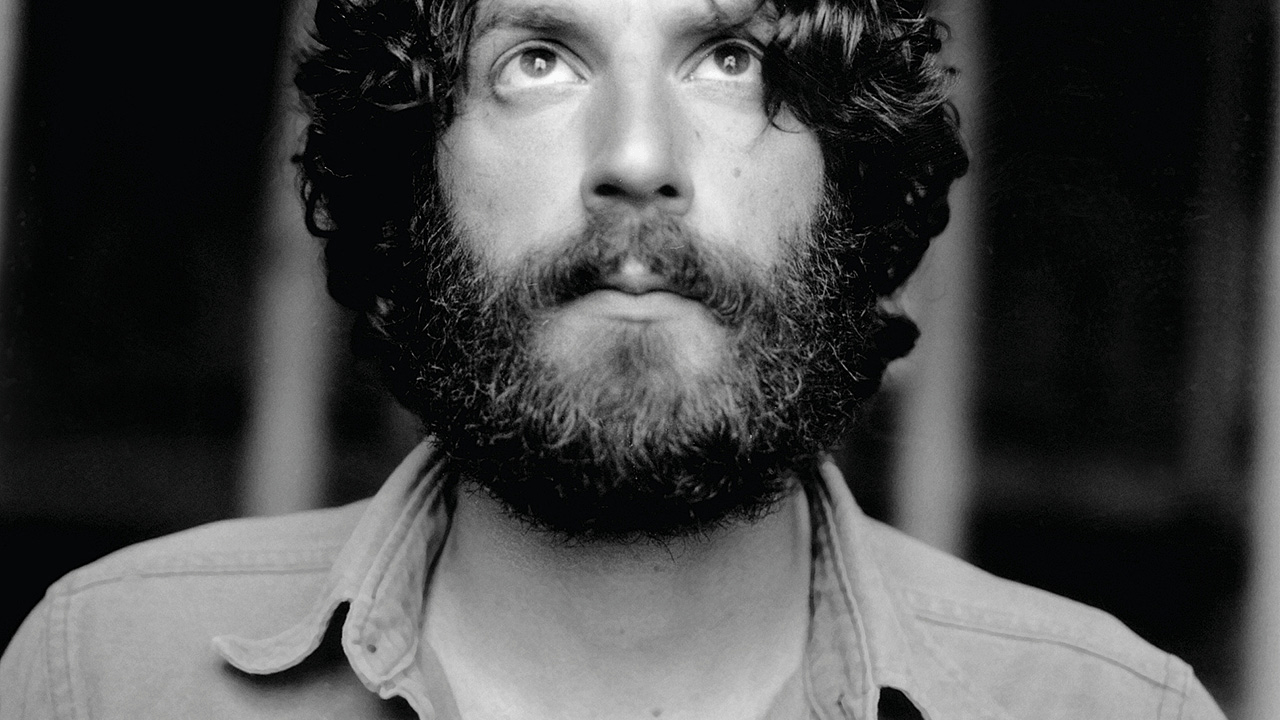
Ray LaMontagne

I’ve written glowingly of Coltrane’s work in the past.  Today, I want to share a few thoughts about a lesser known artist, Ray LaMontagne.

I actually know very little about him as a person.  There aren’t many details on the web.  What you can find are haunting live performances of songs that carry you into a different time and place.  When my heart is aching, Ray can make my heart ache for him — with him — and in that lowness you can actually find a kind of redemption.

I was introduced to Ray’s music by a friend, listened to him a few times, and decided he was just too country for me.  Then, maybe a year later, something moved me to listen again and I found myself sitting in my parked car, dimly aware of my surroundings, as I listed to Ray sing:

I found myself face down in a ditch

Booze in my hair

Blood on my lips

A picture of you, holding a picture of me

In the pocket of my blue jeans.

“I ain’t about to go straight…It’s too late.” — all this from his song “Jolene”.

By the grace of the God that I don’t really believe in (but desperately hope to be wrong), I have never woken up face down in a ditch with booze in my hair and blood on my lips.  But the feeling of being a train wreck in motion, one that nothing can stop, not even love, is something that I can relate to in my own way.  Ray’s music is a catharsis that I wish more people would understand so that I could share it with them.

Or maybe that’s not such a good idea after all.

If you do decide to listen, have someone to call.  And listen to his first few albums.  His new stuff is great, but he’s… well… doing something new.  Good for him.


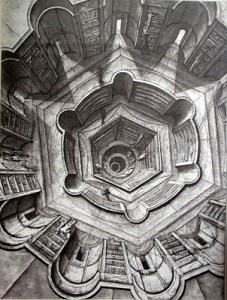
On Building the Library of Babel

library-of-babel

My friend and I spoke of Borges’ Library of Babel:

“Do you think that it could actually be built?”  I asked.

“Of course not!” he said.   “It’s infinite.”

“But is it infinite countably, or infinite uncountably?”

“Uncountably infinite.”

“How could it be?” I ask.  “It it’s made of a finite number of orthographic characters.  It must be circumscribed by some countable infinity.”

“Even so,” my friend says, “it’s still infinite.”

“What if we relaxed the notion of infinity ever so slightly.  What if we said that, for example, it wasn’t necessary to finish every sentence with every possible character.  In fact, let’s say that we imposed a rule of comprehension on the Library of Babel.  Only sentences that make grammatical sense can be included in any volume.”

“You’re talking about something different entirely from what Borges proposed.”

“I suppose I am.  But how many meaningful things can be said?  Are there an infinite number of meaningful thoughts?  Can we say that certain statements reduce to other statements, and count them only as one?”

“My instinct is that there are still infinite things to say.”

“So the library must still be infinite.”

“So it would seem.”

“What if all statements had to be true?”


Blog at WordPress.com.

Up ↑