Search

To Have and Have Not

technical musings and more

PLACES I HAVE BEEN

BEIJING – JULY 1, 1997

In the afternoon, green-shirted soldiers had pushed me with several of my schoolmates out of Tiananmen Square.  The main celebration that evening was invite only.  A giant countdown clock had been sitting for weeks in front of the National Museum.  Blocky characters in red and yellow had been erected in the square facing the Forbidden City to commemorate the occasion:  香港回歸.  The Chinese translates to “Hong Kong returns to the motherland”.  The British simply called it a transfer of sovereignty.

As darkness fell, I took the cheap steel bike I had purchased and rode south from 北京師範大學 (Beijing Normal University), where I was a Chinese student.  The university sits on an artery called 新街口 (Xinjiekou), near the third ring road.  Riding south, I passed the second ring road, a then popular and new shopping area called 西單 (Xidan), and eventually into some 胡同 (hutong) south of there, probably near the intersection of 廣安門大街 (Guanganmen Inner Street) and 菜市口大街 (Caishikiu Street).  This put me a solid ten kilometers from my dorm.

Night had fallen by the time I reached the hutongs.  As I bicycled down the narrow curving streets, the locals showed their own fascination, calling out 老外 (laowai).  “Laowai” is a polite way of calling someone a foreigner, though I’ve routinely heard Chinese use it here in the US to refer to non-Chinese.  This happened most recently during my orderly, but painful forty-five minute wait last Saturday night to get a bowl of authentic Taiwanese herbal jelly, red beans, and taro from the new 鮮芋仙 (Meet Fresh) in Cupertino.  The tofu was sold out, so come early.

Hutongs are traditional Chinese neighborhoods of fairly ancient construction, now endangered species.  As I rode, my way was lit intermittently by floodlights, and the glow of Chinese bodegas, gathering places for the residents.  Above us, the most spectacular fireworks display I had ever witnessed, then or since, was streaming multi-hued glory overhead, giving everything below an eery, tremulous glow.  Yes, I’ve remembered that moment for the rest of my life, but this was that rare situation where I knew right then that I would.

GRAND CANYON NORTH RIM – AUGUST 1989

It was family vacation.  Within a year, my family would be leaving our home in St. Louis for San Jose, but none of this was in the works as of yet.  I was still used to long jaunts through the woods around our house, discovering mud as if I had a detector, and “accidentally” falling into creeks (I was far too expert at my stone-to-stone crossings than to claim an actual fail).  

The north rim of the Grand Canyon isn’t as popular as the south rim.  There are more opportunities to hike in relative solitude.  For the first time in our lives, my parents trusted my twin brother and I to hike alone, down into the canyon, making us pledge that we would return by a certain hour later that afternoon.

We must have had the reckless aim of making it to the bottom because we plunged down the trail with no thought of the difficulty to return.  At last, we lost our nerve to continue. We had spied a little cataract near the left side of the trail.  It spilled into an area like a giant bathtub, and looked suitably deep for swimming.

And jumping.  As I remember, one of us did carefully check the “tub” for any underwater obstructions, but it was easy enough to see from some five to ten meters above that it was crystal clear and free of debris.  We stripped down on one side of the hill facing the tub.  I don’t remember who jumped first.

The water was frigid.  It could have been five degrees off still being snow.  The shock was such that I wondered for a moment if I could move my arms.  Adrenaline must have kicked in at this point because I swam hard for the rocks at one edge.  The experience was terrifying.  I immediately began climbing back up the hill for my second jump.

Michael and I took turns jumping for the better part of an hour.  When we did agree to retire, it was only out of fear that we would not have enough time to climb our return.  Also, I think I mentioned the water was very cold.

Then a minor disaster struck.  While I struggled to get my pants back on, I accidentally brushed one of my shoes.  It rolled down he hill, splashed down, then continued merrily downstream.

I didn’t relish the idea of climbing several miles out of the grand canyon with one shoe.  Michael, bless his heart, went racing off with me to retrieve the shoe.  There was no trail by the creek, so we were poking our way through brush and spider webs, dodging and weaving, knowing all the while that water can move a shoe much faster than we could keep up with it.

Then, I caught sight of it floating upside down, caught behind a large branch.  Nike Air had saved me.  I plucked it from the water and heaved a huge sigh of relief as I put the gloppy shoe back on. 

Hiking back up in a wet shoe was miserable, but I didn’t let myself complain even once.

GLACIER NATIONAL PARK, LOGAN PASS – JUNE 14, 2005

I had the ring hidden in one of my pockets for about forty-eight hours, since we had entered the park.  Today, we were driving from Lake McDonald up Going to the Sun Road to our final destination of the Many Glacier Hotel (these pictures was taken when we reached the hotel that day).

When you reach the Continental Divide, it is called Logan Pass,  Even in our summer month, it was covered in snow, though not uncomfortably cold.  We hiked a few miles along the Hidden Lake Trail until we reached a small boardwalk that comprised the Hidden Lake Overlook.  Fortunately, Cathy was happy when I proposed.  Sadly though, she had to remind me to go down on one knee. I was nervous! The icy landscape and lake below felt like a good omen to me.  Like the hardy natives of the most northern climes, we would learn to live together, with a warmth we create, one to carry us through the hardest winters and storms.

DARTMOUTH COLLEGE – OCTOBER 2006

Dartmouth has a secret spot called the Big Empty Meeting Area or BEMA.  The BEMA is set up in the woods behind Reed and Dartmouth Halls.  If you reach it from high ground, you’re likely to bump into a full size bronze of Robert Frost just sitting on a rock amongst the trees.  He scared me three-quarters to death when I was wandering around in those trees without a flashlight after dark.

The BEMA is a large, yet intimate clearing in the woods with a couple of granite steps left, or maybe put, on one side.  In photographs I see they’ve added some bench seating at one end.  I guess someone thought a little extra seating wouldn’t take away from the magic of the place, and I would say they’re right.

If you come at night, the milky way, in glorious detail, spreads above you, framed by the ring of trees.  The last time I visited the BEMA, I was in it at night alone.  I danced and sang to the forest, stars, and moon.  Some things you can’t explain.   You can feel them though.  My soul was moved by that place, and I take great hope from what I’m told, that it is still there, still the same.

The trees and sprawling stars heard me that night, the wind running through the leaves.  It was one of the strangest, most heartbreaking places I’ve been.

PITCH PIPE BRAIN SCIENCE

Writing about David Rock, Steven Pinker, Lakoff and Johnson in one article got me all excited today.  Now, per my typical school year routine, I am sitting in my son’s Friday night Chinese school class.

From a grammar perspective, Mandarin Chinese is much simpler than the romance languages.  Everything is subject-verb-object.  Even better, the hangover I had from my studies of French was instantly cured when I discovered the Chinese don’t conjugate verbs.  They don’t do it regularly or irregularly.  They don’t do it at all.  I am; you am; he/she/it am; we am; you am; they am.

The trickiest part of learning Mandarin Chinese — or Cantonese or Taiwanese or any of the other dialects for that matter — is learning how to pronounce the pitches correctly.  If you say tang with a singing, flat tone it means “soup” (湯).  A rising tone means “sugar” (糖).  In English, we give a rising tone to the end of our questions.  On my first day in China as a student in 1997, I went to a restaurant and nervously tried to order “soup” (糖).  Some amount of consternation followed, and then a plate of granulated white sugar was finally delivered to me.  This is when I realized my professors were really not kidding when they said we had to learn how to hear and speak the tones.

How did this happen?  The best answer I’ve found was in a piece by John McWhorter in The Atlantic Monthly.  He explains that two words that differ in both consonance and pitch can eventually metamorphosize (he uses the felicitous analogy of the Cheshire Cat) into two words with identical consonance, but different pitch.  He explains this may be something like Cockney’s abbreviation of “breath” and “thing” to “bref” and “fing”.

Now, I will play at being David Rock.  What kind of brain science do we have to explain the mysterious presence of tonal languages in various places around the globe: “East and Southeast Asia; sub-Saharan Africa; and among the indigenous communities of Mexico” (McWhorter)?  I’ll mention a BBC News article later in my post, but for now let’s focus the question by zeroing in on music.  It turns out that brain scientists know something interesting about how tonal languages relate to musical pitch sensitivity.

Scientific American and The New York Times both covered research by Dr.Diana Deutsch, who suggests that,

“for students who speak a tonal language, acquiring absolute pitch is like learning a second language, which becomes much more difficult after a critical period of development. For students who speak a nontonal language such as English, however, absolute pitch is more like a first language, for which the critical period occurs at a much younger age.” (Don Monroe in Scientific American).

I interpret this as saying the Chinese students’ brains are already familiar with pitch when they are introduced to it in the context of music, making it like a second language.  The English students must encounter and master pitch fresh.  Just as the relationship between Romance languages makes it easier for a French speaker to learn Spanish, so the tonality of the Chinese language provides a firmer basis for acquiring perfect pitch.  One advantage to Deutsch’s research is that she did not rely on relatively low resolution fMRI results, but rather on the students’ ability to prove they have perfect pitch.

“60 percent of Beijing students who had begun studying music between the ages of four and five years old passed a test for absolute pitch, whereas only 14 percent of the American students did.” (Don Monroe in Scientific American)

None of this can allow us to conclude that Chinese and other tonal speakers are automatically more musical than non-tonals.  “In both groups, students who started their musical instruction later were less likely to have absolute pitch, and none of the Rochester [non-tonal] students that began training after their eighth birthday had the ability.” (Monroe)  My wife is Chinese and unabashedly tone deaf.  Plainly, some hard work is still involved with acquiring this peculiarly awesome ability.

According to the research quoted in this BBC article — Chinese ‘takes more brainpower’ — Chinese speakers use both sides of their brain, while English speakers use only one.

The researchers believe that this need to interpret intonation is why Mandarin speakers need to use both sides of their brain.

The right temporal lobe is normally associated with being able to process music or tones.

“We think that Mandarin speakers interpret intonation and melody in the right temporal lobe to give the correct meaning to the spoken words,” said Dr Scott.

“It seems that the structure of the language you learn as a child affects how the structure of your brain develops to decode speech.

“Native English speakers, for example, find it extraordinarily difficult to learn Mandarin.” (BBC News as linked above)

In my last cogsci-driven post I disavowed any hold on being an expert of any sort, but I’ve read enough cognitive science to be highly suspicious of the claim that only half an English speaker’s brain is active while he speaks (even if that claim was limited to brain activity specifically associated with speaking).

I find myself in hearty agreement with the final statement though.  Damn skippy!  It’s really hard for a native English speaker to learn Mandarin Chinese.  The tones are the slipperiest part, without a doubt.

Then again, the Chinese struggle pretty hard with English too.  According to one Chinese I met while studying, English has tones too!  This is why saying the word “democracy” as “DEMO-crassy” gets you strange stares, while the correct “duh-MOH-cruh-see” will bring listening comprehension.  The accents and slurs, slides and pauses, rises and falls of English are every bit as labyrinthine to a native Mandarin speaker as the tones of Chinese for the English one.

That’s my story, and I’m sticking to it.

If you’re willing to go along with that hypothesis, then you’re probably ready to agree then that having a brain tuned to pitches is like having a brain tuned to any richly complicated activity: most or all sports, cryptography, debate, writing, etc.  Not all of us have a similar experience, but some of us were studying at a young age, practicing, striving to master our skill in order to obtain some elusive future triumph.  As young children, we all had different goals.  Some of us were truly self-driven and just did it out of love.  Some of us had shown talent and were being pushed towards it.  Still others may have fluctuated between these two.

In all cases, you end up with a person that is a comparative master of her trade.  They say Michael Phelps was a swimming anomaly because he started so late, at age seven.  I started swimming as an infant, as did my son.  Now, four afternoons a week I watch him slowly acquiring one thing in particular:  an innate feel for the water.  Working out will someday be important, and it’s good that he’s getting the feel for that now.  But what he needs to do even more than that is to learn how his body moves in the water: how the rise and fall of his breaths carry him through it, how the angle of his hand determines a change in orientation, what to do with his lips to keep water out of his nose when he’s underwater and facing “up”.  Great swimmers don’t motor through the water, as so many observers expect.  The great swimmers are “tricking” the water.  They’re sliding past, apologizing to it in a million little ways, and slipping towards the real “up” to swimmers: that which lies ahead.

Finally then, what we did as young children had a long and lasting impact on us as adults.  We gained great facility with parts of our world.  In other posts, I’ve talked about how my mother’s love and pressure formed me into a better person.  The vibrations of that love are now rippling through me and over my own children.

The talent of speaking Chinese isn’t enough to have perfect pitch.  You have to study music too.


THE ROOTS OF UNCONSCIOUS BIAS

Root metaphor is one of the most powerful, least known discoveries of the last fifty years.

In a much cited paper, Smith and Eisenberg conclude that the root metaphorical shift from “drama” to “family” served, during a strike, as the driving conflict between employees and management in the perennially joyful world of Disney.  I was introduced to root metaphor by Sarah Allan, who had learned about it from Lakoff and Johnson’s seminal work Metaphors We Live By (MWLB).  

MWLB sits on my desk, where I can easily pull it down and browse its pages.  A root metaphor is a part is an unconscious model by which we evaluate the world around us.  Root metaphors show up in language.  For example, argument is war is a root metaphor that gives English speakers a wide range of phrases like, “I attacked his point.” and “I defended my position.”  In another culture, the root metaphor may be argument is ceremony.  Still more low lying metaphors exist, like good is up:  “things are looking up”; “that business is on the up-and-up”; “she’ll rise to the top”.

In Rock’s SEEDS framework, I see categories of unconscious bias mapping to root metaphor:

Similarity Bias – People like me are better than others

“buddy up”; “let’s stick together”; “we think alike”

All of these phrases have an upbeat, good connotation, just as the similarity bias predicts.

Expedience Bias – If it feels right, it must be true

“I feel good about that”; “go with your gut”; “that rubs me the wrong way”

Experience Bias – My perceptions are accurate

“I have a cloudy view [of some abstract subject]”; “I know it when I see it”;

Distance Bias – Closer is better than far

“Be close”, “be near”, and phrases like them are all expressions of love and friendship.

Safety Bias – Bad is stronger than good

“I’m sunk!”; “lose-lose situation”; “one in a million”

My mappings are imperfect, but the root metaphorical associations to unconscious bias are so easily assigned as to be self-evident.  I would be very surprised if this argument hasn’t already been made somewhere in the literature.

What does it mean for root metaphor and unconscious bias to be “buddied up”?

It is a new inroad to understanding ourselves.  Both frameworks provide considerable insight into our inner workings.  Root metaphor is more of a cogno-linguistic exercise, while unconscious bias deals most directly with neuroscience.

It would be easy to declare this a chicken-and-the-egg situation, but I will insist on a directionality.  The brain’s biases are not derived by brain structure.  Brain structure and how it affects our thought is plainly the vice-strong domain of David Rock.  But Rock talks about how our brain structure affects our ability to multitask, maintain focus, and similar.  When he begins talking about bias, he is talking about higher cognitive function.  Bias may be pre-programmed, but it isn’t an anatomical area of the brain.

Steven Pinker explains how language exposes and affects bias.  Even in the node.js community, there are holy wars over the use of gendered pronouns and how they affect our perceptions of women in the workplace [check out what Pinker has to say about the problem in the Pronouns section of this Wikipedia article].  I am not an expert, so I offer my conclusion humbly:  language is not an outward manifestation of an inward bias.  Language is the bias.  Rock’s SEEDS don’t produce root metaphor, but rather are different manifestations of the same source as that of language itself.  The spinning bias motor of language is what propels SEEDS biases forward.

This is why IF-THEN exercises are so successful.  They force us to put our unconscious bias into language, allowing us to grapple with it directly.  While we may wish to manipulate, we definitely don’t want to rid ourselves of these behaviors.

What would we do if things stopped looking up?

PARADOXES

Is it possible to be someone that you’re not?

If you can conceive of it, is it possible to say that you don’t believe it exists at all?

Do the terms ‘9’ and ‘the number of the planets’ name one and the same abstract entity, yet must still be regarded as unlike in meaning?  Please assume the Pluto debate has been settled in favor of Pluto being regarded (properly) as a planet.

If spanking children worked for my mother, why won’t it work for me?

Why do people often come closer together when one of them begins to move apart?

When Gödel solved relativity by canceling time as a variable out, was it mathematical trickery, or the science fiction novel on which I should now be working?

“By completing a sufficiently long round trip in a rocket ship, a resident of Gödel’s universe could travel back to any point in his own past.” (Jim Holt)

Is it nature or nurture that makes my identical twin brother so different from me?

When I think of something, why do I think of that thing instead of something else?

Would I be happier as a dog?


Would I have been happier one thousand years ago, living in the woods of North America as a native american?  I disallow any arguments against this borne of Woody Allen’s Midnight in Paris.  Yes, I think antibiotics are great.  What makes life worth living though?

Why does my wife insist that there are not different sizes to infinity when I can explain quite clearly that there are?

Why do people say math lacks feelings and emotion when it has plainly been the source of many ugly arguments for centuries or more?

If God did ever actually talk to you, how could you be sure it was God talking?  Do you think you need a witness?  Friend or stranger?  How many?  What would God have to do to prove it was really God?  If you were convinced, would you do whatever God told you to do?

If not everything I’ve asked is a true paradox, would it make it all a paradox for me to ask if it’s all a paradox?  Or would I have to ask that recursively, and without a base case?

Would I be happier as a dog?


Lyrics: “Like Rock & Roll and Radio” by Ray LaMontagne

Are you still in love with me
Like the way you used to be or is it changing?
Does it deepen over time like the river
That is winding through the canyon?

Are you still in love with her?
Do you remember how you were before the sorrow?
Are you closer for the tears
Or has the weight of all the years left you hollow?

Are we strangers now?
Like the Ziegfeld Gal and the vaudeville show?
Are we strangers now
Like rock and roll and the radio?
Like rock and roll and radio

I can see you lyin’ there
Tying ribbons in your hair and pullin’ faces
I can feel your hand in mine
Though were living separate lives in separate places

Are we strangers now?
Like the Ziegfeld Gal and the vaudeville show?
Are we strangers now?
Like rock and roll and the radio?
Like rock and roll and radio

All these white lies hanging like flies on the wall
Hard wired, road tired
Counting curtain calls and waiting
Waiting for the axe to fall

Are you still in love with me
Like the way you used to be or is it changing?
Does it deepen over time, like the river
That is winding through the Canyon?

Are we strangers now?
Like the Ziegfeld Gal and the vaudeville show?
Are we strangers now?
Like rock and roll and the radio?
Like rock and roll and radio

PAPER AIRPLANES

My son asked me for help with his paper airplanes, which are sophisticated enough to require tape.  I have seen his planes fly across rooms in graceful arcs.  As a child myself, my paper airplanes had advanced swiftly to the floor and no further.

I told Elijah that I knew nothing of paper airplanes.  He grimaced in response.

“What do you like about paper airplanes?” I asked.

“I just like how they fly and how they look.” he said.

“When you like how a plane flies, what do you like about it?” I asked.

“You just do it in many different ways.” he said.


GIVING STATUS

Providing your status is part of every workplace.  Even if you work alone, your decision as to whether you should take your own status periodically, perhaps in a journal, is still a decision about giving status.  You have a status, whether you give one to yourself or not.

Agile methodologies introduced the world to the scrum, a meeting often called a standup because it is expected that the attendees — meant to be fewer than a dozen, and more like a half dozen — should each speak for a minute about their status.  When these meetings are run well, they end swiftly.  If the scrum master decides that, on regular basis, the meeting should run to an hour while one of the engineers’ problems is discussed, the attendees can swiftly come to resent it.  I don’t think this potential for abuse is specific to software engineering either.

There are plenty of other situations where giving status is fraught with peril though.  A lot of bosses get status during weekly one-on-one meetings.  Still more bosses pretend they are having weekly one-on-one meetings.  The funny thing is that the bosses that consistently take an hour of your time every week are the ones you wish wouldn’t, while the ones unavailable are the ones with which you really want to talk.

I can’t hide my shock when someone at work asks, “What have you gotten done for the last few weeks?” Human psychology is simple in this case.  Almost everybody will begin carefully combing their records for examples of work getting done.  If you ask them to give you their status in a minute, they’ll take two; in five minutes, they’ll take ten.  “What have you done for me?” isn’t an invitation to know what someone is doing.  It’s an invitation for them to justify the amount of money the company is paying them.

But some managers ask for status in this fashion all the time.  Worse, they turn it into a “standup” that lasts two hours while a large, loosely related group of workers take their turn giving status.

The funny thing is that if you ask someone, “Hey, what have you been up to lately?” they’re likely to give you a short, informative answer.  I think the problem is with time.  The Agile standup is effectively asking something like, “what have you been up to lately?” which, since it covers a single work day, doesn’t really require the justification of one’s pay (though, by experience, some scrum team members will still see it this way).   Agile has figured something out that project managers everywhere are still ignoring.

Still, you can’t expect to get away with giving status in standups alone.  What are some productive ways that just might work?

  • Allow an individual to journal his status on a blog or a wiki.  As long as he keeps it up-to-date, it becomes an asynchronous way of letting people know his status.  Remind him with software to regularly post updates.
  • Designate a “status proxy” ahead of a meeting, and have her collect the status of all the participants asynchronously before the call.  During the call, let the “status proxy” do all the speaking, leaving time for questions to the individuals when she is done.  Change the “status proxy” with each meeting.  This eliminates the significant overhead of each individual “standing up” and “sitting down” during the call, an amount of time I have found to be extraordinary.
  • Ask each “status proxy” to journal what they learned as part of presenting.
  • Have a simple form for individuals to fill out with questions about their status.  Make form responses visible to all individuals.
  • If  you must have an “all hands on deck” type call where anybody and everybody should speak, start the call with a prioritization discussion.  Who should go first?  It’s generally easy and fast to do this.  Then, if you run out of time, you’ve covered the most important topics.

If a “status proxy” does all the talking, will the individuals be listening?  Were they listening with the old, “everybody talks” model?  The “status proxy” means a shorter, more focused meeting.  People are more likely to stay involved, and nobody is concerned they’ll be caught on mute when someone calls out for them.

I have David Allen’s book Getting Things Done on my desk.  Maybe that means that, sometime soon, I will be.


David B. Martin Saves Mount Diablo

Today was the Mount Diablo Challenge, an 11.2 mile bicycle ride up Mount Diablo.  CA Technologies sponsors the event every year, and I’ve heard Mike Gregoire brag about it in town hall meetings.  He should.  Not only are the racers supporting the land conservation efforts of Mount Diablo’s myriad stewards — many of them volunteers — but the ride itself is just glorious.  You feel damn good about helping save Mount Diablo when you reach its peak.

Speaking of reaching its peak, most of the riders in this race are very serious cyclists.  While mountain bikers (like me) could register and participate in the race, I saw only a handful.  The “peloton” was a hardened group that finished the eleven miles and almost four thousand feet of elevation gain in less than an hour, last year almost a hundred of them.  Look at the road bike times from last year’s results.  According to Google, cars finish this course in about forty-five minutes.  The speed limits vary from twenty to twenty-five miles per hour along the way.  Yes, there were some insanely fast bicyclists out on the hill this morning.

I cannot, however, say that I was one of them.  When I registered, I knew I could finish the course, this from past experience climbing nasty hills near my home in south San Jose.  But I broke my shoulder falling from a cycle three years ago, and it made me shy about riding.  Apart from a few days on the stationary cycle this week, it was my first time back on the bike since my accident.  Heck, if you’re going to get back in the game, why not go big?  I figured the muscles were all still in there and that they just needed a little waking up.

I was kind of right about that.  It took me about three miles to warm up, but then I felt good for most of the race.  I was moving at a snail’s pace compared to the real riders, but I never stopped once until I was within the last half-mile of the summit.  I have a number of stories I could tell you about the race, but I thought this would be the most entertaining.  I am going to describe the events that took place as I closed the last few hundred yards to the summit.

save-diablo-challenge

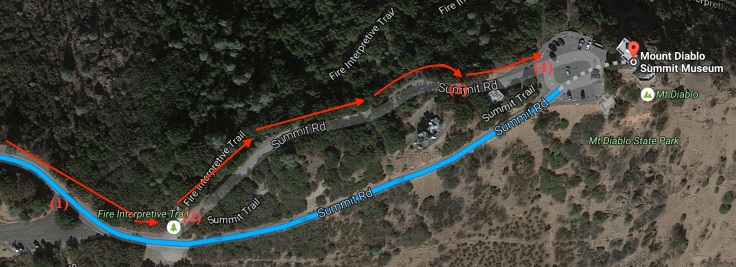
I hope the map is fairly self-explanatory.  I traveled along the path of the red arrows from left to right in order to reach the summit, easily identified by the circular parking lot and the Google label saying “Mount Diablo Summit Museum”. 🙂

Pay attention to the numbers in parentheses.  Three is kind of hidden, but it’s the one to the left of four.  🙂

As I approached the summit, I was exhausted.  I had finally started to take some rests because I figured it would be better to finish with a slower time than really lay myself out trying to get up there as fast as I could.  The problem with allowing yourself to take a rest is that you then allow yourself to take another one.  And then a third.  Progress grinds to a relative halt.

Still, I did finally close in on the summit.  As I passed (1), I saw a most curious site.  About fifty cyclists were all poised to begin their descent behind a bit of police tape in a driveway at my right.  I remembered that the descents were to happen in waves, and realized this must be the first group to descend (I hadn’t seen anyone descending on my way up).  That means I had suddenly found myself face to face with the fastest cyclists on the mountain that day.

One cyclist called out to me:  “Great job!”  I was stunned, but managed a thank you.  Then a few more called out.  All at once, the whole damn group of cyclists erupted into applause.

I was shocked.  There was a steep bit of road right ahead, within the view of my fans, and I decided to punk it up as hard as I could.  Off I went, muscles screaming.

As soon as I reached the top of what really amounted to a minor uptick, I was heaving wind and ready to die. That would be at point (2) on the map.  The cyclists poised to descend could no longer see me, so I took a chance to have a good long rest and let my breathing recover.  I had no idea how much more nonsense the road had in store, but I was going to have to baby myself up from here.  That little bit of showboating had cost me.

On my next stretch, I made it to (3).  I was starting to despair.  This length road must have had more than a 15% grade and I was already exhausted.  Did I really have the chops to finish the race?  I heard later they call this last stretch of road “the wall”.  Aren’t things like this always called “the wall”?

Then I heard someone calling out to me.  I looked up the nasty hill of road and now saw a person waving at me from the top.  He was at (4) on the map.  It was the finishing line.  “Come on!” he said.  “You can do it!”  God bless that guy.

Indeed I could.  Indeed I did.

For the curious, saddle soreness was the most painful part of the ride.  Make sure your butt is ready for one of these, even if you think you’re tough.  I’m not sure I’m going to be able to sit down tomorrow.


DBM


ANGRY WITH GOD

During his travels, a fabric merchant came upon another man who was under a barren tree at the side of the road.  This other man was stomping around and cursing up a storm.  His animals stood nearby, watching disinterestedly, as if they had seen all this before.  The angry man didn’t even register the approach of his fellow traveler.

The fabric merchant stopped near the tree and spoke up to greet the angry man:  “You there!  What seems to be the matter?”

“Seems?!!  Seems to be the matter?!!!” asked the angry man.  “Nothing seems to be the matter.  Everything actually is the matter!”

Chagrined, the merchant replied, “Come now!  Your situation can’t be so dire.  You appear to be uninjured.  You have your livestock, and it looks like they’re still carrying whatever it is you sell to make a living.  If you really do have some major problem unseen to me, you can always call upon me to help you or at least go find aid on your behalf.”

“No, no, no.  You don’t get it.  This is all God’s fault!”

“What is God’s fault?”

“All this.  Everything.  You’re in it.”

The fabric merchant was confused.  “In what?”

“Do you believe in God?” asked the angry man.

“Yes.” said the fabric merchant.

“Then you believe that God created us, everything…. all this.”

The fabric merchant saw where this was headed.  “I see where you’re going with this, but I don’t see how this is anybody’s fault.  God may have created it, but is God responsible for every last disaster, minor and otherwise?”

Now the angry man smiled.  “Yes!  Yes, He is!”

The fabric merchant didn’t even bother to ask how the angry man knew this with such certainty.  “Well, so what are you doing now?  Being angry at God?”

“Yes.”  The angry man’s head waggled furiously.

“How long do you intend to stay angry?”

“As long as it takes.”


Blog at WordPress.com.

Up ↑